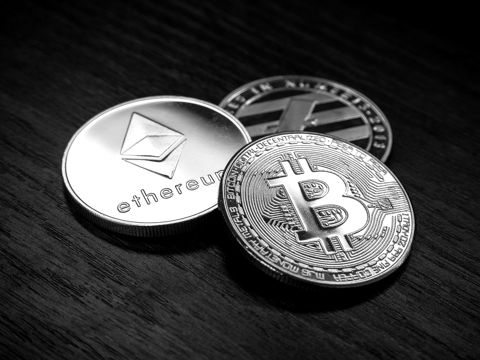
What is Bitcoin?
Bitcoin began as a short paper about electronic cash without a bank and became the template for the cryptocurrencies that followed. Here is how the machine actually runs.
 Bitcoin
Logos are trademarks of their respective owners, shown for identification only. Their use does not imply endorsement. Licences.
On this page
- Bitcoin is both a network and its currency (BTC), designed to send payments directly between people without a financial institution.
- Payments are recorded on a public blockchain; a new block is added about every 10 minutes on average.
- Only 21 million bitcoins will ever be created, and each one divides into 100,000,000 units called satoshis.
- Confirmed Bitcoin payments cannot be reversed; only the recipient can send funds back.
- Bitcoin is not anonymous: every transaction is stored publicly and permanently.
Bitcoin is a digital currency and the open network that runs it. Payments go directly between users and are recorded on a public blockchain secured by proof-of-work mining. Its rules cap supply at 21 million coins, and confirmed payments cannot be reversed.
What is Bitcoin, in one paragraph?
Bitcoin is two things with one name. Bitcoin (capital B) is a network of computers running open-source software that keeps a shared record of payments. bitcoin or BTC (small b) is the currency that moves on that network. The design was described in a white paper titled Bitcoin: A Peer-to-Peer Electronic Cash System, signed by Satoshi Nakamoto. According to bitcoin.org, Nakamoto published the first specification and proof of concept on a cryptography mailing list in 2009.
The goal, set out in the paper's first sentence, was a purely peer-to-peer version of electronic cash so that online payments could go directly from one party to another without a financial institution. To do that, Bitcoin had to solve the double-spending problem without a central referee. Its answer was a public blockchain that thousands of independent computers check.
How does a Bitcoin payment actually go through?
Bitcoin has no accounts in the bank sense. Your wallet holds keys, and the blockchain records which keys can spend which coins. A payment follows a fixed path:
You sign. Your wallet creates a transaction and signs it with your private key, proving you control the coins.
The network checks. Nodes verify the signature and that those coins have not already been spent.
Miners bundle it. Miners collect valid transactions into a candidate block and compete to solve a proof-of-work puzzle.
A block is added. The winner broadcasts the block; other nodes accept it only if everything in it is valid. Bitcoin.org says this happens about every 10 minutes on average.
Confirmations pile up. Each later block buries your payment deeper and makes it harder to reverse.
The miner who finds a block receives newly created bitcoin plus the fees attached to the transactions inside, an incentive the white paper describes directly. The full mechanics are in how Bitcoin mining works, and the payment's inner structure is in how crypto transactions work.

How many confirmations does a Bitcoin payment need?
A payment with zero confirmations is only a promise floating around the network. Bitcoin.org gives rough guidance on how much to trust a payment as blocks are added on top of it:
| Confirmations | How bitcoin.org describes it | Where it might fit (our reading) |
|---|---|---|
| 1 | Somewhat reliable | Small, low-risk payments |
| 3 | Mostly reliable | Everyday amounts |
| 6 | A good minimum for high-value transfers | Large payments, exchange deposits |
| 30 | Suggested during emergencies | When the network is under unusual stress |
Why is the supply of bitcoin capped?
Bitcoin's rules set the money supply in advance. Bitcoin.org's FAQ states that only 21 million bitcoins will ever be created. New coins enter circulation as mining rewards at a decreasing, predictable rate: the number created each year is automatically halved over time, an event known as the halving.
Each bitcoin can be split into 100,000,000 satoshis, so the coin is divisible to eight decimal places. You do not need to buy a whole bitcoin; most people hold fractions.
Is Bitcoin anonymous or private?
Neither, fully. Bitcoin.org states plainly that Bitcoin is not anonymous and cannot offer the same level of privacy as cash. Every transaction is stored publicly and permanently, and anyone can look up the balance and history of any address with a block explorer.
What the ledger does not show is your name. The white paper's privacy model relied on keeping public keys unlinked from identities. That link is often made anyway, for example when you buy bitcoin on an exchange that checks your identity. Bitcoin is better described as pseudonymous: your address is a public pen name.
What mistakes do beginners make with Bitcoin?
- Expecting a refund button. Bitcoin.org notes that transactions cannot be reversed; they can only be refunded by the person who received them.
- Losing the keys. Lost bitcoins stay dormant forever because nobody can recover the private keys. Read crypto wallets explained before you hold any.
- Reusing addresses. Bitcoin.org recommends using each address only once to limit how much of your history can be linked together.
- Ignoring taxes. Bitcoin.org reminds users that taxes may apply in their jurisdiction; in the US, the IRS treats digital assets as property.
- Confusing Bitcoin with Bitcoin products. A spot bitcoin ETF gives price exposure through a brokerage, but you never hold the keys.
Questions readers ask
Who created Bitcoin?
Someone using the name Satoshi Nakamoto, who wrote the white paper and published the first specification and proof of concept. According to bitcoin.org, Satoshi left the project in late 2010 without revealing much about himself.
Do I have to buy a whole bitcoin?
No. One bitcoin divides into 100,000,000 satoshis, so you can hold any fraction down to 0.00000001 BTC.
Is Bitcoin legal?
Bitcoin.org says Bitcoin has not been made illegal by legislation in most jurisdictions, though some countries restrict or ban its use. Check your local rules.
What happens when all 21 million bitcoins are mined?
No new coins will be issued. The white paper anticipated that transaction fees could then fund the incentive for miners.
Bitcoin is a public ledger, a fixed issuance schedule and a mining process bundled into one open network. Its strengths, no central operator and predictable supply, come with sharp trade-offs: irreversible payments, public histories and full responsibility for your own keys. Understand those trade-offs before you hold any.
Sources
- Satoshi Nakamoto (bitcoin.org), Bitcoin: A Peer-to-Peer Electronic Cash System (2008)Primary source
- bitcoin.org, Frequently Asked Questions (2024)Primary source
- bitcoin.org, Some things you need to know (2024)Primary source
- Bitcoin Project (developer.bitcoin.org), Developer Guide: Transactions (2024)Primary source
- National Institute of Standards and Technology, NIST IR 8202: Blockchain Technology Overview (2018)Primary source
- US Internal Revenue Service, Digital assets (2025)Primary source
Educational content only — not financial, investment, legal or tax advice. Crypto-assets are high-risk and you could lose all the money you put in. Rules differ by country; check with your national regulator. See our risk disclosure and editorial policy.
Read next
- Crypto Basics · Beginner
What is cryptocurrency?
Digital money kept on a shared ledger: how it works, how it differs from a bank account, and the risks.
- Mining, Staking & Infrastructure · Beginner
How does Bitcoin mining work?
What miners compute, how difficulty keeps blocks near 10 minutes, and why most miners join pools.
- Mining, Staking & Infrastructure · Beginner
The Bitcoin halving explained
The 210,000-block rule that halves new supply, the math behind the 21 million cap, and the price myths.
- Networks & Ecosystems · Intermediate
The Bitcoin Lightning Network
Payment channels, routed payments and invoices on Bitcoin's layer 2 — and what you must watch for.