How do crypto transactions work?
Pressing "send" in a crypto wallet starts a chain of checks by strangers around the world. Knowing those steps explains fees, delays and why mistakes are permanent.
On this page
- A crypto transaction is a message signed with your private key that tells the network to move funds.
- Nodes check the signature and the balance, then the transaction waits in a pool until a miner or validator puts it in a block.
- Bitcoin spends whole "unspent outputs" and returns change to you; Ethereum adjusts account balances directly.
- Fees reward whoever adds your transaction; on Ethereum, fee = gas used × (base fee + priority fee).
- Once confirmed, transactions generally cannot be reversed, so the address you paste must be right.
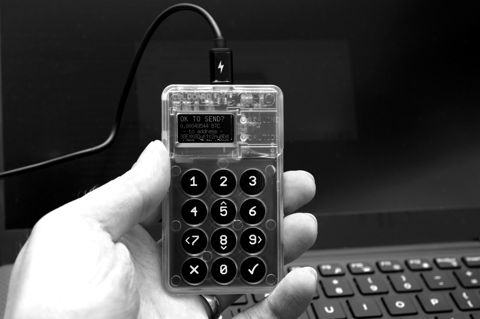
A crypto transaction is an instruction signed with your private key and broadcast to the network. Nodes check the signature and that the funds are unspent. A miner or validator, paid by your fee, then adds it to a block, and each later block makes it harder to reverse.
What is inside a crypto transaction?
Strip away the app and a transaction is a small data package. ethereum.org defines Ethereum transactions as cryptographically signed instructions from accounts. Whatever the network, the package answers the same questions:
- Who is paying? Proven by a digital signature made with the sender's private key. The key itself is never revealed.
- Who is being paid? The recipient's address.
- How much? The amount to transfer.
- What fee? What the sender offers for inclusion in a block.
On Ethereum, the fields also include a nonce, a counter that numbers each transaction sent from your account, plus limits on gas and fees. Values are counted in wei, where 1 ETH equals 1018 wei. Bitcoin's original white paper described the idea in its simplest form: an electronic coin is a chain of digital signatures, each owner signing the coin over to the next.
What happens after you press send?
The broad path is the same on Bitcoin and Ethereum, although the names differ.
Your wallet signs and broadcasts the transaction. Nodes check it and pass it on. It then waits in a pool of pending transactions, the mempool. A block producer, a miner on Bitcoin or a validator on Ethereum, picks transactions from the pool, usually favoring those that pay more, and puts them in a block. Other nodes check the block and add it to their copy of the ledger.
From there, the transaction gains strength with time. On Bitcoin, each new block on top adds a confirmation; bitcoin.org suggests at least 6 for high-value transfers. On Ethereum, ethereum.org explains that blocks become "justified" and then "finalized", after which reversing them would be extremely costly.
How do Bitcoin and Ethereum track balances differently?
Here Bitcoin and Ethereum part ways, and the difference explains some confusing wallet behavior.
| Question | Bitcoin (UTXO model) | Ethereum (account model) |
|---|---|---|
| What is a "balance"? | The total of unspent outputs your keys can spend | A number stored for your account |
| How is a payment made? | Whole outputs are spent; leftover value returns as change | The amount moves from one balance to another |
| How is the fee set? | Inputs minus outputs; priced by transaction size in bytes | Gas used × (base fee + priority fee), paid in ETH |
| How a past payment is referenced | By transaction ID plus output number | A per-account nonce numbers each transaction |
| Typical block interval | About 10 minutes on average | 12-second slots |
Bitcoin's developer guide explains that when a wallet shows a balance, it really means coins waiting in one or more unspent transaction outputs (UTXOs). Outputs must be spent in full, like paying with a banknote: you hand over the whole note and get change back.
Why do transaction fees change?
Block space is limited, so users compete for it. On Bitcoin, the developer guide says fees are priced per byte of transaction data, and miners tend to pick the highest fee per byte first. Fees rise when demand for block space rises.
On Ethereum, the protocol sets a base fee that moves with demand and is burned, and you add a priority fee (tip) for the validator. ethereum.org's formula is gas used × (base fee + priority fee). A plain ETH transfer uses 21,000 gas; more complex smart-contract actions use more. We work through a full fee example in what is Ethereum, and define the term in gas fee.
Can a crypto transaction be reversed or traced?
Reversed: generally no. Bitcoin.org states that a Bitcoin transaction cannot be reversed and can only be refunded by the person who received the funds. The FTC gives the same warning for crypto payments in general, contrasting them with card payments, which come with dispute rights.
Traced: often yes. The FTC notes that transactions are recorded on a public blockchain, where addresses and amounts are visible and can sometimes be linked to real people. Anyone can look up a transaction using a block explorer, which is also the best way to check whether your own payment has been confirmed.
What mistakes do beginners make when sending crypto?
- Typing or pasting the wrong address. Check the first and last several characters every time. Malware and address poisoning can swap in look-alike addresses.
- Choosing the wrong network. Sending a token on a network the recipient's wallet does not support can strand it.
- Sending tokens to a contract. ethereum.org estimates at least $83.6 million in ERC-20 tokens have been lost to contracts that cannot handle them.
- Skipping a test. For large or first-time transfers, send a small amount, confirm it, then send the rest.
- Panicking over a pending transaction. Look it up on a block explorer before sending again, or you may pay twice.
Questions readers ask
How long does a crypto transaction take?
It depends on the network and the fee. Bitcoin adds a block about every 10 minutes on average; Ethereum uses 12-second slots. Waiting for several confirmations or finality takes longer.
Why did I pay a fee when sending a token, not ETH?
On Ethereum, every transaction consumes gas, and gas is paid in ETH regardless of which token you move.
What is change in a Bitcoin transaction?
Because Bitcoin outputs must be spent in full, the leftover amount is sent back to an address you control as a change output.
Can I cancel a crypto transaction?
Once confirmed, it can only be returned by the recipient, as bitcoin.org explains. Before confirmation, what you can do depends on your wallet and the network, so check your wallet's documentation rather than paying anyone who offers help.
A crypto transaction is a signed message that strangers verify and record. Fees buy a place in a block, and confirmations make the result harder to undo. Because there is no bank to call afterward, the checks you make before pressing send are the only safety net you have.
Sources
- Bitcoin Project (developer.bitcoin.org), Developer Guide: Transactions (2024)Primary source
- ethereum.org, Transactions (2025)Primary source
- ethereum.org, Gas and fees (2025)Primary source
- bitcoin.org, Some things you need to know (2024)Primary source
- bitcoin.org, Frequently Asked Questions (2024)Primary source
- Satoshi Nakamoto (bitcoin.org), Bitcoin: A Peer-to-Peer Electronic Cash System (2008)Primary source
- ethereum.org, Blocks (2025)Primary source
- US Federal Trade Commission, What To Know About Cryptocurrency and Scams (2024)Primary source
- ethereum.org, ERC-20 Token Standard (2025)Primary source
Educational content only — not financial, investment, legal or tax advice. Crypto-assets are high-risk and you could lose all the money you put in. Rules differ by country; check with your national regulator. See our risk disclosure and editorial policy.
Read next
- Crypto Basics · Beginner
Crypto wallets explained
Wallets hold keys, not coins. Custodial vs self-custody, hot vs cold, and how each can fail.
- Glossary · Definition · Beginner
Mempool
The waiting room for unconfirmed transactions, and how fees decide who goes next.
- Glossary · Definition · Beginner
Block explorer
The search engine for a public blockchain, and how to read a transaction page.
- Security & Privacy · Intermediate
Phishing and address poisoning
Lookalike sites and lookalike addresses: how both scams work and the habits that defeat them.