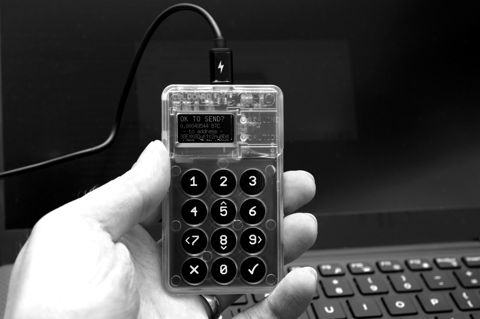
What is a crypto address?
The string you paste into a send box is public by design. What makes it work is the secret key you never paste anywhere.

On this page
A crypto address is a public string that identifies where coins or tokens can be sent on a blockchain. It is derived from a public key, so sharing it is safe — but whoever holds the matching private key controls whatever arrives there.
What does a crypto address look like?
An address works like an account number for a blockchain: you give it to someone so they can send you funds. NIST's blockchain overview describes addresses as short alphanumeric strings derived from a user's public key with a hash function, sometimes with extra data such as a version number and a checksum to catch typos. They are often shown as QR codes so a phone can scan them.
The exact format depends on the network. On Ethereum, the official docs say an address is the last 20 bytes of the Keccak-256 hash of the public key, written in hexadecimal with 0x in front. Bitcoin's developer glossary describes classic addresses as a 20-byte hash encoded with base58check.
How is an address different from a private key?
A wallet holds three related pieces. Mixing them up is the most expensive confusion in crypto, so it is worth seeing them side by side. For the full picture, read crypto wallets explained and our entry on the private key.
| Piece | Share it? | What it does |
|---|---|---|
| Private key | Never | Creates the signatures that authorise spending |
| Public key | Can be public | Lets others verify those signatures |
| Address | Yes — that is its job | A shorter identifier derived from the public key, used to receive funds |
Is it safe to share your address?
Yes, in the sense that nobody can spend from an address just by knowing it. NIST stresses that addresses are not secret: they are the public "to" and "from" points of every transaction. The trade-off is privacy. Anyone can paste your address into a block explorer and see its balance and history, which is why NIST calls this pseudo-anonymity rather than anonymity. Some users generate several addresses to keep activities apart.
To see how an address fits into a full payment, read how crypto transactions work.
What mistakes do people make with addresses?
- Checking only the first and last few characters. Scammers create lookalike addresses and plant them in your history — see address poisoning. Compare the whole string.
- Typing an address by hand. Copy it or scan the QR code, then confirm it on the receiving device.
- Ignoring the network. Some networks share the same address format, so make sure sender and receiver use the same chain.
- Skipping a test. For a large transfer, a small first payment shows the address works before the rest follows.
Questions readers ask
Can I have more than one crypto address?
Yes. A wallet can generate many addresses, and NIST notes that users of public blockchains often do so to keep different activities apart.
Does creating an address cost anything?
On Ethereum, the developer docs say creating a key-controlled account costs nothing; you pay fees only when you send a transaction. Deploying a smart contract does cost, because it uses network storage.
Is an address the same as a public key?
No. The address is derived from the public key with a hash function, which makes it shorter and easier to share.
An address is where funds are sent; the private key is what controls them. Share the first freely, protect the second completely, and always check the full address and network before you press send.
Sources
- ethereum.org, Ethereum accounts (developer documentation) (2026)Primary source
- National Institute of Standards and Technology, NISTIR 8202: Blockchain Technology Overview (2018)Primary source
- Bitcoin Project (developer.bitcoin.org), Bitcoin developer glossary (2026)Primary source
- ethereum.org, Ethereum glossary (2026)Primary source
Educational content only — not financial, investment, legal or tax advice. Crypto-assets are high-risk and you could lose all the money you put in. Rules differ by country; check with your national regulator. See our risk disclosure and editorial policy.
Read next
- Glossary · Definition · Beginner
Private key
The secret that signs transactions, how it links to addresses, and why it cannot be reset.
- Crypto Basics · Beginner
Crypto wallets explained
Wallets hold keys, not coins. Custodial vs self-custody, hot vs cold, and how each can fail.
- Security & Privacy · Intermediate
Phishing and address poisoning
Lookalike sites and lookalike addresses: how both scams work and the habits that defeat them.
- Glossary · Definition · Beginner
Block explorer
The search engine for a public blockchain, and how to read a transaction page.