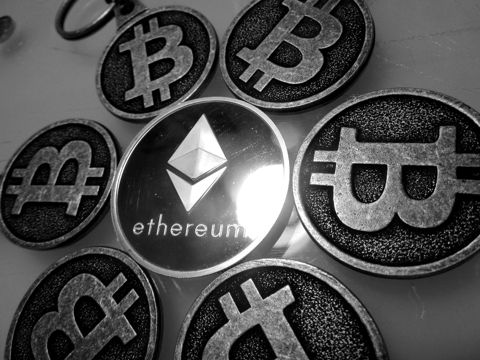
Coins vs tokens: what's the difference?
The labels sound interchangeable, and regulators often lump them together. For anyone sending or holding crypto, though, the difference decides which fees you pay and who can change the rules.
 Bitcoin
 Ethereum
Logos are trademarks of their respective owners, shown for identification only. Their use does not imply endorsement. Licences.
On this page
- In common usage, a coin is the native asset of its own blockchain, such as bitcoin on Bitcoin or ether on Ethereum.
- A token is created by a smart contract on an existing blockchain; on Ethereum, many follow the ERC-20 standard proposed in November 2015.
- Moving a token still costs a fee in the host chain's coin, so a wallet holding tokens but no ETH cannot send them on Ethereum.
- Tokens add a layer of risk: the issuer's contract and promises, not just the blockchain, decide what the token is worth.
- "Coin" and "token" are not legal categories; the SEC and IRS use broader terms such as crypto asset and digital asset.
A coin is the native currency of its own blockchain and pays that network's fees, like bitcoin or ether. A token is created by a smart contract running on someone else's blockchain, such as an ERC-20 token on Ethereum. Tokens depend on both the host chain and the contract's issuer.
What is a crypto coin?
A coin, in the sense most people in crypto use the word, is the built-in asset of a blockchain. It exists because the network's own rules create it, and it pays for using that network.
- bitcoin (BTC) is native to Bitcoin. Its rules, not any company, cap supply at 21 million, according to bitcoin.org.
- ether (ETH) is native to Ethereum. ethereum.org calls it the native cryptocurrency that powers the network, used to pay transaction fees and to stake.
Because the coin is part of the protocol, changing how it works requires the network's participants to adopt new software. No single issuer can freeze it or print more on a whim. That is the main thing a coin offers that most tokens do not.
What is a crypto token?
A token is an asset defined by a smart contract, a program running on an existing blockchain. The contract keeps a list of who holds how many tokens and the rules for moving them. The blockchain underneath does the recording and security.
On Ethereum, most fungible tokens follow ERC-20, a standard proposed by Fabian Vogelsteller in November 2015. It defines a common set of functions, such as checking a balance, transferring tokens and approving someone else to spend them, so that wallets and exchanges can handle any compliant token the same way. ethereum.org lists the range of things tokens can represent: points on a platform, in-game items, shares in a company, fiat currency such as US dollars, or even gold.
That is why many stablecoins are, technically, tokens: despite the "coin" in the name, they are contracts issued on an existing chain to represent dollars. Even ether gets a token version: ethereum.org explains that ETH can be wrapped into WETH, an ERC-20 token, because many applications expect that format.

How do coins and tokens compare side by side?
| Question | Coin | Token |
|---|---|---|
| Where does it live? | On its own blockchain | Inside a smart contract on another chain |
| Who creates new units? | The protocol's rules | Whatever the contract allows, often the issuer |
| Pays network fees? | Yes, on its own chain | No; fees are paid in the host chain's coin |
| Can someone freeze or change it? | Only by network-wide agreement | Possibly, if the contract gives the issuer that power |
| Main extra risks | Network security, price swings | Contract bugs, issuer behavior, fake copies, plus the chain's risks |
| Examples | BTC, ETH | ERC-20 tokens, most stablecoins, wrapped ETH (WETH) |
Why do you need a coin to send a token?
Every Ethereum transaction requires a fee in ETH, ethereum.org explains, and that includes token transfers. The token contract runs on Ethereum's computers, and the fee pays for that work. Many beginners discover this the hard way: they receive tokens in a new wallet, try to move them, and the wallet refuses because the ETH balance is zero.
The fee formula is covered in what is Ethereum. If you use a different smart-contract chain, check its official documentation for which coin pays the fees.
Are coins and tokens treated differently by regulators?
Not by those labels. The SEC's investor site uses the umbrella term crypto asset, which it says covers assets known as tokens, digital assets, virtual currencies and coins, and adds that their characteristics and risks vary significantly. The IRS uses digital asset for anything recorded on a cryptographically secured distributed ledger, naming cryptocurrencies, stablecoins and non-fungible tokens (NFTs) as examples, and treats all of them as property for US tax purposes.
What matters to regulators is what an asset does and what rights it carries, not whether it is called a coin or a token. Our SEC vs CFTC guide explains how US agencies divide that question.
What mistakes do beginners make with coins and tokens?
- Trusting a name or ticker. Anyone can deploy a token contract with any name. Confirm the official contract address from the project's own documentation.
- Forgetting the gas coin. Keep a small amount of the host chain's coin in any wallet that holds tokens.
- Sending tokens to the token's own contract or another contract. ethereum.org estimates at least $83.6 million in ERC-20 tokens have been lost to contracts that could not handle them.
- Assuming a token shares the coin's guarantees. A token on Ethereum is only as reliable as its contract and issuer.
- Granting unlimited approvals. The ERC-20 "approve" function lets apps spend your tokens; see token approvals explained.
Questions readers ask
Is a stablecoin a coin or a token?
Technically, a stablecoin issued on Ethereum or a similar chain is a token: a smart contract on someone else's blockchain. The word "coin" in the name is a label, not a technical category.
Is an NFT a token?
Yes. An NFT is a non-fungible token, meaning each unit is unique, unlike ERC-20 tokens where every unit is identical. The IRS lists NFTs among digital assets.
Are coins safer than tokens?
Not necessarily. A coin avoids the extra contract and issuer layer, but it still carries network and price risk. The FTC warns that crypto values can change rapidly, even hour to hour.
Is ether a token?
No. ETH is Ethereum's native coin. Wrapped ether (WETH) is an ERC-20 token version of it, created because many apps require the ERC-20 format.
A coin runs a blockchain; a token runs on one. That distinction tells you which asset pays the fees, who can change the rules and how many layers of risk you are taking on. Before holding a token, find its official contract address and keep some of the host chain's coin for gas.
Sources
- ethereum.org, What is ether (ETH)? (2025)Primary source
- ethereum.org, ERC-20 Token Standard (2025)Primary source
- bitcoin.org, Frequently Asked Questions (2024)Primary source
- US Securities and Exchange Commission, Crypto Assets (Investor.gov spotlight) (2025)Primary source
- US Internal Revenue Service, Digital assets (2025)Primary source
- ethereum.org, What is Ethereum? (2025)Primary source
- ethereum.org, Gas and fees (2025)Primary source
- US Federal Trade Commission, What To Know About Cryptocurrency and Scams (2024)Primary source
Educational content only — not financial, investment, legal or tax advice. Crypto-assets are high-risk and you could lose all the money you put in. Rules differ by country; check with your national regulator. See our risk disclosure and editorial policy.
Read next
- Crypto Basics · Beginner
What is Ethereum?
A blockchain that runs programs: ether, gas fees, smart contracts and what the Merge changed.
- Stablecoins & Payments · Beginner
What is a stablecoin?
Tokens designed to stay at $1: what backs them, how redemption works, and why runs happen.
- Security & Privacy · Intermediate
Token approvals and wallet drainers
What you allow when you click Approve, how drainers exploit it, and how to revoke old permissions.
- Glossary · Definition · Beginner
Gas fee
What you pay to get an Ethereum transaction processed, with the formula worked through.